Root Canals in Moorgate, EC1
Root canal treatment in Moorgate — carried out with CBCT 3D imaging and a dental operating microscope — is available at City Dental Clinic, located at 35 Chiswell Street, EC1, a short walk from Moorgate and Barbican Underground stations.
We believe that precision diagnosis and precision treatment are inseparable. That is why we use cone beam CT scanning to map your tooth in three dimensions before we begin, and why we complete most root canal treatments under a microscope. The result is a standard of care that is not widely available at a general dental practice.
At City Dental, our Root Canals are mostly completed by Dr Ani Ohanyan. She is an expert in Root Canals, and her calm and gentle approach will instantly make you feel at ease. She has advanced training in root canals, using modern techniques to acheive the best outcomes. With her help, we have saved countless teeth over the years.
What is root canal treatment?
Root canal treatment — also known as endodontic therapy — removes infected or inflamed pulp tissue from inside the tooth. The pulp is the soft tissue containing nerves and blood vessels that fills the centre of the tooth and extends down into the roots. It can become infected as a result of deep decay, a cracked tooth, or trauma.
If pulp infection is left untreated it can spread to the surrounding bone, cause a dental abscess, and ultimately result in the loss of the tooth. Root canal treatment eliminates the infection, cleans and seals the canals, and allows the tooth to be restored and kept — which is always our preference over extraction.
Modern root canal treatment, carried out under local anaesthesia with the right technique and equipment, is straightforward and comfortable. Most patients find it no more difficult than having a filling.
Symptoms that may indicate you need root canal treatment
Symptoms can vary considerably. Some patients experience significant pain, while others have no symptoms at all and an infection is only detected on an X-ray. Common signs include:
- Persistent toothache or severe pain when biting or chewing
- Prolonged sensitivity to hot or cold that does not settle quickly
- Discolouration or darkening of the tooth
- Swelling or tenderness in the gum around the tooth
- A persistent pimple or sinus on the gum (a sign of abscess)
- A cracked or broken tooth with sensitivity
- A tooth that has previously been root treated and is becoming painful again
- No symptoms, but infection or bone loss visible on X-ray
If you are experiencing any of the above, we recommend booking a consultation. We will examine the tooth and take imaging — including a CBCT 3D scan where clinically indicated — to give you an accurate picture of what is happening before we discuss any treatment.
CBCT 3D X-ray: diagnosis you can rely on
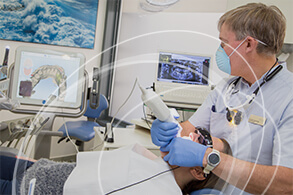
At City Dental we use the Vatech Pan-oral 2D/3D X-ray system — one of the most capable cone beam CT units available in dental practice. A CBCT scan produces a detailed three-dimensional image of the tooth, root canals and surrounding bone.
Unlike a conventional 2D periapical X-ray, a CBCT scan shows us:
- The exact number of root canals present — some teeth have more than a standard X-ray suggests
- The precise shape, curvature and length of each canal
- The full extent of any infection or bone loss around the root tips
- Any canals that were missed during a previous root canal treatment
- The relationship of the root tips to nearby anatomical structures
- Cracks or fractures in the root that would affect the prognosis
This information changes how we plan and carry out treatment. We are working from an accurate, three-dimensional map of your tooth rather than an educated estimate. For complex cases, retreatment cases, or where a 2D X-ray leaves unanswered questions, CBCT imaging is invaluable.
Microscope-guided root canal treatment
We complete most root canal treatments using a dental operating microscope, which provides magnification of up to 25 times. This is significantly beyond what is possible with standard dental loupes — and a world away from working with the naked eye.
Under this level of magnification, our clinicians can:
- Identify and negotiate fine, narrow or calcified canals that are easily missed
- Detect additional canals not visible at standard magnification
- See hairline cracks in the tooth structure that affect treatment planning
- Clean and shape canals more thoroughly and with greater precision
- Identify the causes of failed previous root canal treatment
Clinical evidence consistently shows that microscope-assisted endodontics improves outcomes. It reduces the risk of leaving untreated infection behind and increases the long-term success rate of the treated tooth. For a patient, it means a more thorough job — and a better chance of keeping the tooth for life.
Premium materials as standard
The quality of materials used during root canal treatment directly affects how well the tooth is sealed against reinfection. We use nickel-titanium rotary instruments for canal shaping, effective irrigants for thorough disinfection throughout the root system, and high-quality gutta-percha and sealer for obturation. Where appropriate, we use bioceramic sealing materials that bond to the dentine and provide a superior long-term seal.
We do not compromise on the materials we use. The investment in quality pays dividends in the longevity of the treated tooth.
What does root canal treatment involve?
Treatment is typically carried out over one or two appointments, depending on the complexity of the case and whether infection is active at the time of treatment. The process at City Dental is as follows:
- Consultation and 3D diagnosis. We examine the tooth, take a CBCT scan where indicated, and discuss the findings with you. You will leave with a clear treatment plan and cost breakdown.
- Root canal treatment. Under local anaesthesia and working with the operating microscope, we clean and shape all root canals, removing infected tissue and disinfecting the canal system thoroughly.
- Canal sealing. Once the canals are disinfected and dry, we seal them with biocompatible materials to prevent reinfection. A temporary or permanent coronal filling is placed.
- Final restoration. A root-treated tooth is more brittle than a vital (alive or non root-filled) tooth. In most cases we recommend a crown to protect it and restore full function. We will discuss the most appropriate restoration for your tooth.
Aftercare
A root-treated and crowned tooth can last a lifetime with proper care. Brush twice daily, clean between the teeth, and attend regular check-ups so we can monitor the tooth on X-ray. Even after successful treatment, it is important to have periodic review appointments to confirm the surrounding bone is healthy and the seal remains intact.
If at any point you notice symptoms returning — including swelling, pain, or sensitivity — contact us promptly so we can assess the tooth.
Why choose City Dental for root canal treatment in Moorgate?
- CBCT 3D cone beam imaging used for diagnosis where clinically indicated — giving us a complete picture of your tooth before treatment begins
- Root canal treatment completed under an operating microscope as standard, providing magnification of up to 25x
- Premium endodontic instruments, irrigants and sealing materials throughout
- Experienced clinicians with a special interest in endodontics
- A calm, unhurried environment with options available for nervous patients
- Centrally located in Moorgate EC1, within easy walking distance of Moorgate and Barbican Underground stations
- Referrals from other dental practices welcomed
Frequently asked questions
Is root canal treatment painful?
It should not be. Treatment is carried out under local anaesthesia and most patients are pleasantly surprised by how straightforward the experience is. The pain associated with root canals is usually the infection itself — not the treatment. We take extra care with anaesthesia for nervous patients, and sedation options are available if needed.
Why use a microscope rather than loupes?
Dental loupes typically provide 2–4x magnification. An operating microscope provides up to 25x, with co-axial illumination that lights the canal directly. At that level of magnification, fine canal anatomy, cracks and missed canals become visible that simply cannot be seen at lower magnification. It is a meaningful clinical difference.
Do I definitely need a CBCT scan?
Not every case requires one. For straightforward root canals where a conventional X-ray gives a clear picture, we may proceed without it. For complex cases, multi-rooted teeth, retreatment of previous root canals, or where a 2D X-ray leaves important questions unanswered, a CBCT scan is strongly recommended. We will discuss whether one is needed at your consultation.
How many appointments will I need?
Many root canal treatments can be completed in two visits. Cases involving active infection, complex anatomy, or retreatment of a previously treated tooth may require additional appointments. We will give you a clear indication at your consultation.
What is the post-treatment recovery from a root canal?
Most patients feel comfortable enough to return to normal activities, including work, on the same day. It is common to experience some mild tenderness around the treated tooth for two to five days after the appointment — this is a normal inflammatory response as the surrounding tissues settle. Over-the-counter pain relief such as ibuprofen or paracetamol is usually sufficient to manage any discomfort. The tooth may feel slightly sensitive to biting pressure for a short time, particularly if there was active infection before treatment. Significant or worsening pain, swelling, or a return of symptoms after the initial recovery period are not normal and you should contact us promptly if they occur.
What happens after root canal treatment?
A root-treated tooth usually requires a crown to protect it from fracture. With a crown and good oral hygiene, the tooth can last many years — often a lifetime. We will discuss the most appropriate restoration as part of your treatment plan.
What is the success rate of root canals?
When carried out to a high standard, root canal treatment has a success rate of around 85–95% over a ten-year period, depending on the tooth, the extent of infection, and the quality of the final restoration. At City Dental, we use CBCT 3D imaging and an operating microscope specifically because they improve on the outcomes achievable with conventional techniques — reducing the risk of missed canals, incomplete cleaning, and inadequate sealing, all of which are common causes of treatment failure. A well-restored tooth — typically with a crown — that is maintained with good oral hygiene and regular check-ups gives you the best possible chance of keeping it for life. We are always transparent about prognosis: if imaging suggests that the long-term outlook for a tooth is poor, we will tell you honestly at the consultation stage.
How much does a root canal cost?
The cost of root canal treatment at City Dental depends on the tooth being treated and the complexity of the case. Typically, a root canal costs between £750 and £950 per tooth. Back teeth (molars) have more canals than front teeth and therefore take longer to treat, which is reflected in the fee. Where a CBCT 3D scan is required for diagnosis, this is charged separately and we will always discuss whether one is clinically necessary before proceeding. We provide a full written cost breakdown at your consultation before any treatment begins, so there are no surprises. Please call us on 020 7638 0870 or visit our fees page for current pricing.
Do you accept referrals from other dentists?
Yes. We accept referrals for root canal treatment and retreatment from other dental practices. Please call us on 020 7638 0870 or use our online contact form to refer a patient.
Where are you located?
City Dental Clinic is at 35 Chiswell Street, London EC1Y 4SE. We are within easy walking distance of Moorgate Underground station (Northern, Circle, Hammersmith & City, and Metropolitan lines) and Barbican station (Circle, Hammersmith & City, and Metropolitan lines).